


House Hacking: The Profitable Path to Home Ownership
House hacking not only reduces housing costs – it also offers a fast track to financial freedom.
A Constant Quest for Affordable Housing
Millions of Americans live in expensive housing markets. Cities and towns once accessible to working class Americans are no longer cost-effective options. Although pay skyrocketed over the last five years in some industries, many Americans suffer from wage stagnation. With rising rents and limited affordable properties, workers face an uncomfortable choice. They can downgrade their homes for cheap and undesirable dwellings or increase their transportation time to access affordability. Both options are lousy.
The Solution: House Hacking
An attractive and increasingly popular answer to this problem is house hacking, a term coined by real estate investor Brandon Turner in 2013. House hacking is a real estate investment strategy where an owner-occupant earns money by renting out a part of a primary residence. This increases the home’s value by forcing unrealized profit from tenants and generating passive income for owners. In pricey housing markets house hacking is a surefire way to generate wealth quicker.
Where Hacking Happens
House hacking is most common in locations where it’s too expensive for middle class Americans to own a home and make their mortgage payments easily. Although investors in New York, San Francisco and Los Angeles were early adopters of house hacking given their high-priced economies, its use in more affordable markets like Charlotte, Denver and Austin are on the rise. Online forums such as BiggerPockets, Reddit, City-Data.com, and Facebook’s Real Estate Investing Club help house hackers by connecting them to information, resources and other investors.
Popular Places to Unpack the Hack
Even letting out a small part of a primary residence can wield an enormous impact on a house hacker’s bottom line. An influx of funds can offset fixed expenses or free up money for other investments or savings. Although in some locations realizing returns from house hacking is possible through buying multifamily properties (which will be discussed later), many house hackers find it easier to buy a single-family home with monetizable features. House hacks can occur in converted garage space, finished basement/basement apartments, affordable dwelling units (ADUs), extra bedrooms, supplementary space within a larger home, tiny/in-law homes built on primary residence lots, Airbnbs or multifamily units.

Converted Garage
Converting a garage to living space is one of the most dynamic (and even DIY!) house hack strategies. Converting a garage to living space is an appealing way for many house hackers since it creates more and naturally separated square footage in a primary residence. It can also serve as the basis for an ADU. Coverting a garage costs several thousand dollars to bring to code and between $1,500 to $6,000 to finish the floors, walls and ceiling. Most converted garages also require added insulation. Online resources can help inform garage transformations and offer suggestions to make it affordable – our favorites are here and here.
Finished Basement/Basement Apartment
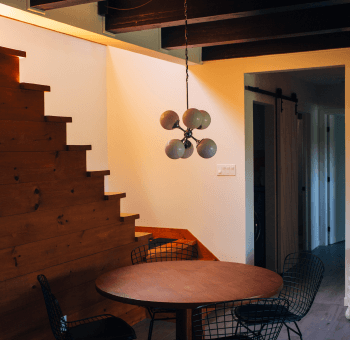
Renting a finished basement is a straightforward approach to house hacking as it entails having a tenant lodge inside a primary residence in a space that is already heated/cooled. Many finished basements are large and comfortable enough to accommodate one-two tenants
If a finished basement has a kitchenette, separate entrance and full bathroom the necessity for the house hacker to interact with the tenant is also limited. In this case the space would function as a basement apartment.

ADUs
ADUs are separated, permitted structures added to a property. They include heating, electricity, and plumbing. ADUs are also called guest houses or in-law units. They must be authorized for rental use or allowed in an HOA. More information on buying or building an ADU can be found here and here.

Extra Bedrooms in a Single-Family Home
The most common house hack is renting a bedroom in a primary residence to a roommate who can use most/all the home’s common spaces. This is the simplest house hack approach since there is generally no renovation/construction cost. The more bedrooms a property has, the more areas an owner can rent out. Although square footage is a good feature of any primary residence, the number of bedrooms matters most.

Supplementary Space
In many homes supplementary space can be converted into bedrooms and used for house hacking. Bonus rooms, lofts, sunrooms and extra living rooms are good candidates for conversion. Adding bedrooms enables more rentable space. For some ideas on converting bonus or extra rooms to bedrooms, consider reading the many ideas suggested online.

Airbnb
Airbnb or other short term rental companies allow owners to house hack parts of their primary residence or properties built on their primary residence land. There are pros and cons of running an Airbnb, as explained here. To check your numbers, we recommend using AI to analyze pricing. Our favorite tool is Mashvisor which has a sleek user interface and supplies both short- and long-term rental return forecasting.

Multifamily Housing
Buying a property with multiple units is the most well-known version of house hacking, and in many cases the most profitable. It can also cover not only mortgage payments, but also generate passive income. Homes with four units or less are considered residential, so house hackers can finance them with a traditional mortgage. This can translate to as little as a 0% down payment if using a VA or USDA loan, or 10% if a hacker or the property itself does not qualify for these products.
Hacking Considerations
2. The neighborhood. House hacking is easier when the home appeals to tenants. Prospective tenants tend to care about where the home is located, how close it is to transportation and amenities, the crime rate, the school district and the overall look/feel of the community. Many successful home hackers find it beneficial to give tenants access to neighborhood parks, pools, gym facilities and other conveniences. Also consider what the local municipality will allow when it comes sharing a residence with non-relatives. Be sure to check with the local zoning department.
3. The population growth and job market. The number of rentals and average rental price for those properties, which can be cross checked on tools like Zumper, Rentometer or Zestimate.
Financial Factors
House hacking is attractive given the profit it generates compared to mortgage and housing expenses. Americans typically spend 25-50% of their income on housing. It makes sense that many would jump at the chance to lower or cut this cost.
1. This said, the process of setting up a solid house hack is not uniformly easy – and it’s all in the numbers. There are many financial factors to consider when weighing whether a property could be a profitable house hack. Our top recommendations are:
2. Conduct market research to find the right property.
3. Write off the taxes associated with home ownership like the mortgage interest deduction.
4. Buy close to a city where multiple transportation options exist.
5. Don’t buy in an HOA that does not allow flexible renting options
The Case Against House Hacking
The argument against house hacking is that it would not work in the context of relationships within a home. In other words, the approach is possible, but not practical for families or couples who value privacy. This concern is valid, as in many cases house hackers share space with others. House hacking also means more work and compromise when occupying the space in a home. Lastly, house hacking is not quickly scalable as an investment type. Creating more hacks would mean moving to another primary residence or adding more dwelling space to an existing property.
Summing it Up
In today’s increasingly expensive market there is no reason to settle for undesirable dwellings. House hacking can help pay a mortgage, increase cash flow and provide practice as a profit-making property owner. It can also minimize housing expenses and generate passive income to grow wealth and pave the road to financial freedom.
Forgotten to take our quiz?
Head over to find out what kind of investor you are and receive personalized content.